



In Pinocchio by Guillermo del Toro, there is a brilliant scene in which the protagonist, crushed by rejection and loneliness, enters a church and sees a wooden crucifix of Jesus Christ. He cries out in confusion, asking why people love Jesus carved from wood, yet refuse to accept a wooden boy. In the end, what is the difference between them?
Pinocchio, the puppet carved by Geppetto — that Prometheus of Tuscany — has long been a story through which children learn about the consequences of lying and the desire to become better versions of themselves. At the same time, it is also a deeply human-centered story, since the puppet’s greatest wish is to become a real boy of flesh and blood. Because Pinocchio is already a puppet by nature, the story has often found its place in puppet theater.
Even so, director Mateo Spiazzi and actor Miha Bezeljak, in Pinocchio by Maribor Puppet Theatre, managed to offer a fresh and original reading of Carlo Collodi’s famous character. At the heart of their interpretation is the idea of transformation — the journey from puppet to human being. Their answer is wonderfully simple: Pinocchio changes by making mistakes. It is through mistakes, and through the act of failing, that we become human.
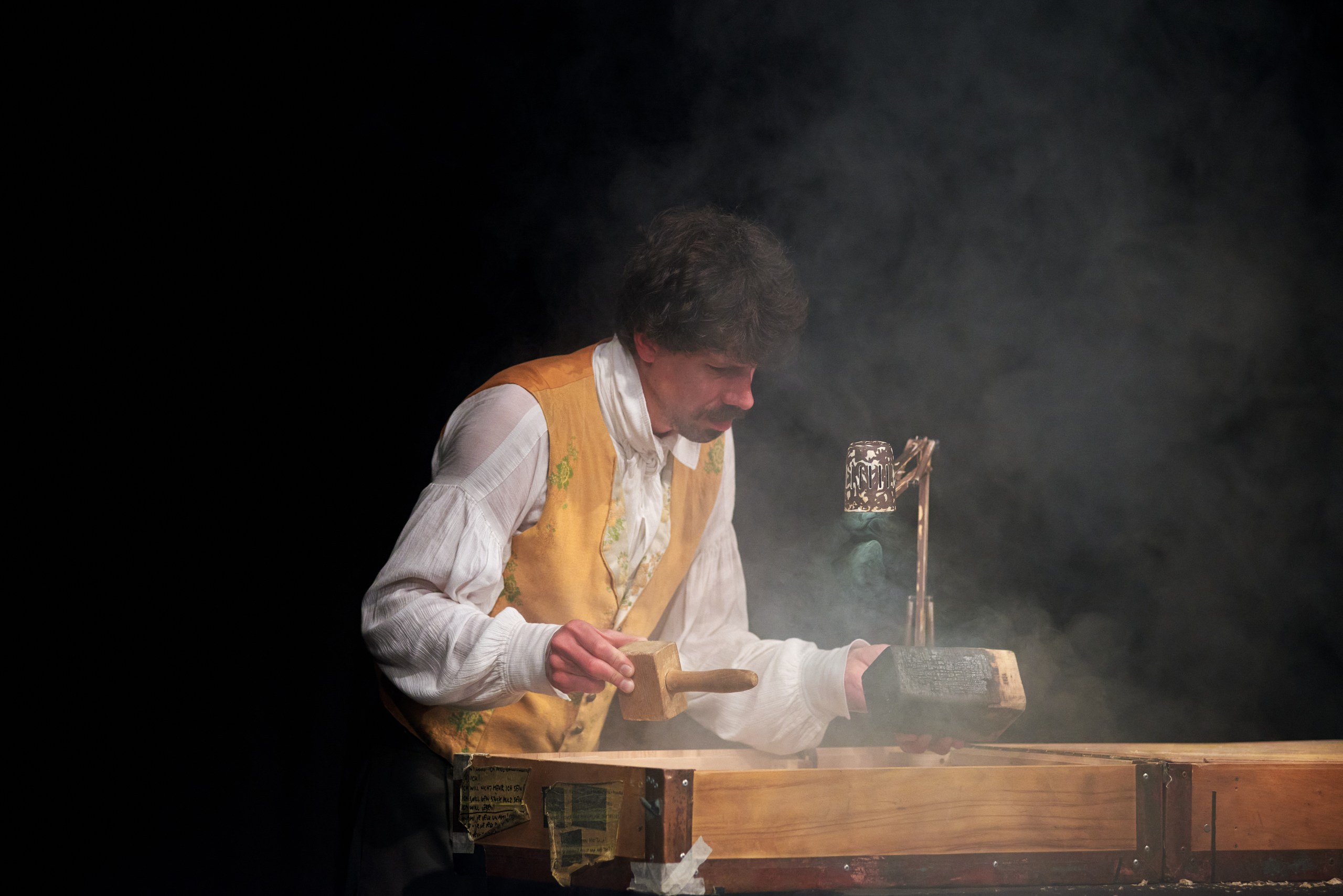
When storytelling, form, and narrative come together in the right way, the audience can do little more than sit quietly, watch, and take it all in. That is exactly what happens in Maribor’s Pinocchio. From the very beginning, the production feels like a love letter to theater itself, as the actor invites us into the space while still making final adjustments to the set and props. Through simple interaction, casual conversation, and humor — along with laughter and footsteps sinking into soft wood shavings — we are gently drawn into the world of the performance.
The remarkable Miha Bezeljak moves effortlessly between several roles: animator, actor-narrator, Carlo Collodi himself, Geppetto, and finally Pinocchio. He shifts between these positions with ease, never losing clarity or control. Pinocchio, in turn, begins as a rough piece of uncarved wood, worked on with simple carpentry tools. Object theater here opens up a wide range of possibilities, and it feels as if everything that can be done with wood, tools, and imagination is explored to the fullest.
Just as interesting is the way the puppets develop throughout the performance, slowly moving from something abstract toward something more concrete, and finally toward the actor’s own body. The journey starts with raw wood, then carved pieces, then wooden objects — like an inkwell and alphabet blocks in the school scene — then a marionette when Pinocchio becomes a donkey, and finally a simple carved wooden figure without strings in the scene inside the whale. As Pinocchio changes and makes mistakes, the puppets also become more defined and more “formed” pieces of wood (puppet and set design by Primož Mihevc). After his final mistake, Pinocchio becomes human, and his identity is fully shaped.
Rather than offering moral lessons or warning against wrong choices, this Pinocchio focuses on the process itself and on learning through experience. The creators avoid over-psychologizing the story, heavy explanations, clichés, and any underestimation of the audience’s intelligence (the performance is intended for viewers aged 15+). Instead, they place at the center a celebration of puppetry and the idea that every failure simply opens another chance to try again — better, or sometimes just differently.
At first glance, the stage looks like the workshop of a somewhat messy and clumsy carpenter. But this only adds to the production’s charm and in no way suggests something improvised or carelessly made. Although the set is made up of just two shelves — or perhaps more accurately, wooden trunks — it still feels as if an entire universe could emerge from the planks and sawdust around them.
Bravo, Maribor! And thank you for the playfulness, the respect and trust shown to the audience, the lack of pretension, the storytelling, and above all, the deep love for puppetry.