



Absurdity, eccentricity, madness, boldness, curiosity, courage – these are all necessary and desirable states for creating and watching theatre for children and young audiences. As André Breton wrote in the Manifesto of Surrealism: “The fear of madness must not force us to lower the flag of imagination to half-mast.” One such production, unafraid of its own madness and proudly raising the banner of imagination high above this year’s Festival, is Andraci, Jepuri and Other Most Important Monsters of Petrovgrad and Central Banat, directed by Nikola Zavišić, based on the novel of the same name by Vojislav Despotov and the children’s novel Petrovgrad Dust, performed by the ensemble of the Toša Jovanović National Theatre from Zrenjanin.
Vojislav Despotov’s character alongside a panel of “municipal experts” tasked with ranking monsters according to their level of frightfulness, introduces us to the strange creatures that inhabit – or once inhabited – Banat, living alongside and terrifying its people. There is the jepur, the most fearsome of them all, a runaway Roma entertainer; the slute, creatures resembling sirens; the andraci, beings that sneak into a person and compel them to behave foolishly; the completely harmless white bakery mouse; Grandpa Mita’s donkey, guilty of several horrifying deeds; and the štrk whose presence sends people into endless laughter.
Director Nikola Zavišić remains faithful to his recognizable theatrical language and aesthetics – live cameras and video on stage, exaggeration, repetition, randomness – as well as to his particular style of humor, built on splitting words into syllables, variations and repetitions, and associative dialogue that resembles the direct transmission of thought itself. The director’s stylistic signature merges seamlessly with Despotov’s literary voice, both in theme and in writing style. The diversity and eclecticism of Despotov’s prose, together with the deliberately incoherent dramatization created collectively by the ensemble, go hand in hand with the production’s equally eclectic staging.
The visual world of the production (overall design by Blagovesta Vasilev) collides the aesthetics of silent cinema, comic books, and contemporary video art. The stage becomes a kind of laboratory of imagination, dominated by the interplay of light and shadow, while the use of live cameras allows the audience to observe the Banat monsters from unexpected angles, emphasizing their grotesque, mystical, and absurd qualities. The actors – Kristian Kardoš, Snežana Popov, Marija Pantin, Predrag Grujić, and Nataša Milišić – navigate skillfully through this hybrid form of lecture theatre, video performance, and puppetry. Particularly striking is the scene in darkness when Grandpa Mita’s donkey appears, constructed entirely from colorful beams of light before transforming into Grandpa Mita himself. Equally memorable is the scene in which plastic cups, originally used to create rhythm while summoning the slute, gradually form a galloping donkey.
The production also serves as a powerful affirmation of Despotov’s literary work. Translating his language into such an intriguing theatrical vocabulary encourages audiences unfamiliar with his books to seek them out and discover what other monsters lurk in the folklore of Banat.
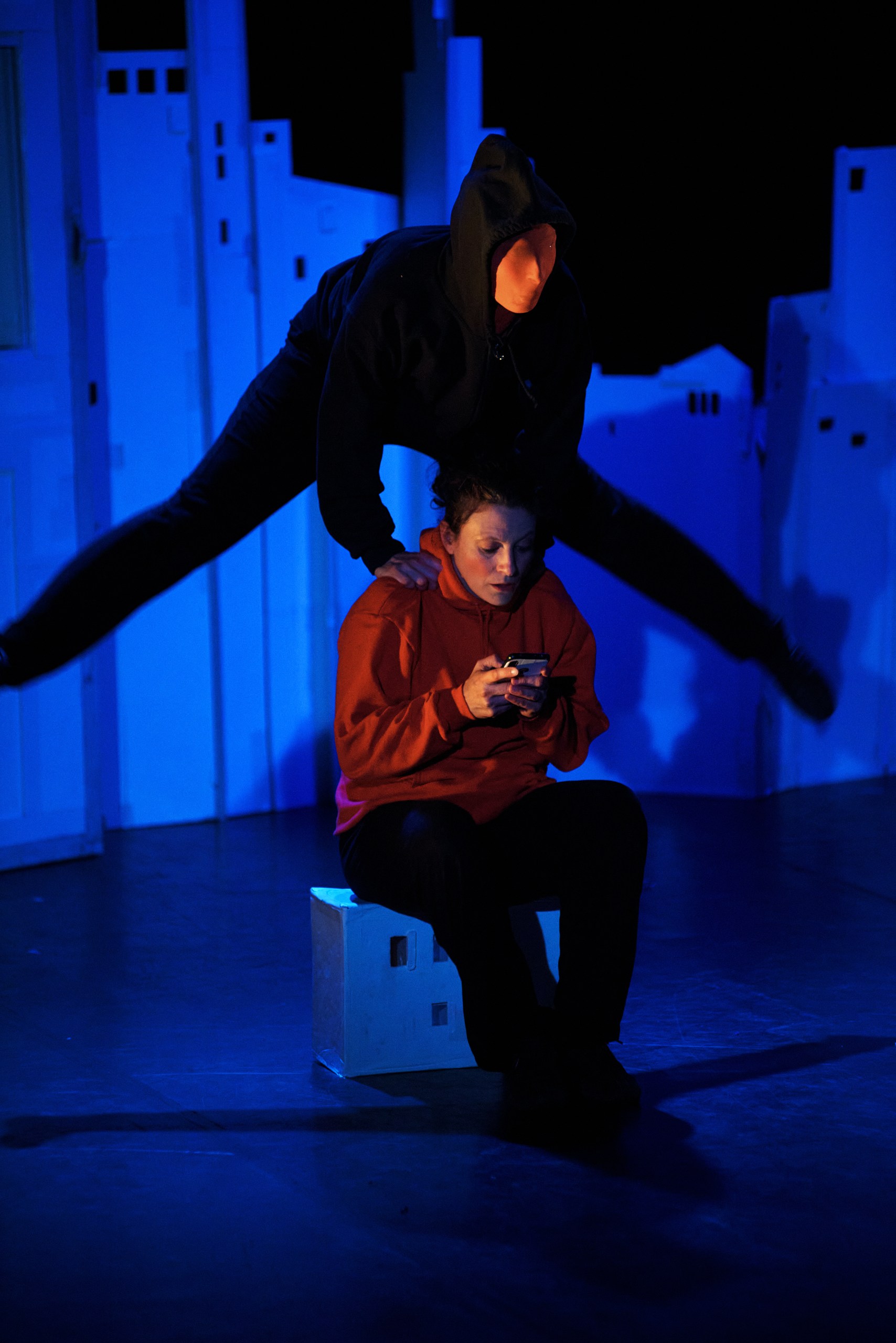
The final performance of the Festival’s third day was the dance production Alice in the Wonder Box by Sara Mangano and Pierre-Yves Massip of the Mangano-Massip Company from Bonny-sur-Loire, France. It explores yet another monster of the contemporary age: puberty – or more precisely, the internet during puberty, and the ways teenagers escape reality into the digital world. Inspired by Lewis Carroll’s Through the Looking-Glass, the sequel to the famous Alice’s Adventures in Wonderland, the production relocates the story into a digital universe. Alice, standing on the threshold of adolescence, confronts bodily changes and the pressures imposed by society and the online world. Yet the selection of scenes often feels rather arbitrary. On one hand, the freedom the creators give the audience to interpret the scenes and construct meaning is admirable; on the other, staring at Rorschach blots for too long can become exhausting. A shorter running time, stronger pacing, and a clearer dramaturgical thread would help articulate the production’s ideas more effectively.
For me, the most poetic moment was the dance of the three Alices: teenage Alice, an older Alice, and puppet Alice, symbolizing the child within. Physical transformation and maturation are beautifully conveyed through the interplay between puppetry and performance. Every puppet – like the world’s most famous puppet, Pinocchio – dreams of becoming human when it grows up, only to discover that freedom is far more difficult than imagined. The video projections create a claustrophobic sensation of being trapped inside a screen, while simultaneously pointing to the fragile privacy of young people in a world governed by algorithms. Teenagers cannot hide from social media, not even behind closed doors. Although the production at times struggled to establish communication with the audience, it nevertheless succeeded in portraying adolescence as a difficult and confusing period – an immensely comforting message for its target audience. Teenagers often believe they are alone in their feelings or that what they are experiencing is permanent and unchangeable. Through Alice, they could recognize themselves and understand that their emotions and struggles are real and valid.
Whether audiences embrace these productions or not is ultimately beside the point. Though very different in genre and theme, both productions are united by a willingness to take risks – especially within the context of theatre for children and young people in Serbia. Exposing audiences, particularly young audiences, to different forms of theatre, perhaps even frustrating or confusing them at times, is a necessary condition for growth: for overcoming the fear of madness and raising one’s own flag of imagination. And that can only benefit theatre as a whole.