The number of submissions for the Fifth International Festival of Professional Theatres for Children and Young People, “Novi Sad Theatre Festival,” has exceeded all our expectations. This stands as clear evidence that the festival—hosted by the Youth Theatre and the City of Novi Sad—has secured its place among the most prominent and prestigious European festivals dedicated to children and young audiences.
This year, the role of selector was entrusted to the three-member Artistic Council of the Festival. Out of nearly four hundred submitted productions, we selected nine which, in our view, stand out for their quality, artistic approach, and the ways in which they address sensitive yet relatable themes for children and young people.
This year’s festival program is marked by productions that, alongside outstanding acting or dance, make use of puppetry, puppeteering techniques, or various objects as significant means of artistic expression. The selected performances reflect contemporary theatrical tendencies in combining different art forms and genres, as well as the use of new technologies and techniques to further engage the modern young audience.
The selected productions also reflect the authenticity of local poetics, aesthetic practices, and social contexts of the countries they come from, offering insight into the development and importance of theatre for young audiences in their respective environments. Presenting these diverse artistic approaches within the field of performing arts will contribute to the exchange of knowledge and cultural perspectives, enrich the cultural life of Novi Sad, and deepen the understanding of different artistic traditions.
We wish the audience, as well as all participants, guests, and colleagues, an inspiring experience—one filled with the magic of theatre and the discovery of its new possibilities and aspirations.
Artistic Council of the Novi Sad Theater Festival/selectors:
Jury members Tamara Kučinović (president), Irina Somborac and Divna Stojanov, after watching the last performance of the Novi Sad Theatre Festival competitive selection, stated that they "miss" more awards, i.e. that there were additional aspects and performances that would have been rewarded if they had had space for them. An example of this is the music for the play "The Adventures of Little Juju", a bold step into the realm of experimentalism made by the play "Bloop", an award for the young actress Mina Nenadović in the play "In the Ceiling the Stars Are Shining”. All this points to the quality of this year's selection. They also praised the genre, aesthetic and thematic diversity of the selection, the opportunity that the festival offers the audience to watch non-verbal, experimental, traditional, puppet shows, theater objects...
DECISIONS AND EXPLANATION OF THE JURY OF NOVI SAD THEATRE FESTIVAL, THE FORTH INTERNATIONAL FESTIVAL OF PROFESSIONAL THEATER FOR CHILDREN AND YOUNG PEOPLE
Expert jury: costume designer Irina Somborac, director Tamara Kučinović (president of the jury) and playwriter Divna Stojanov, after watching ten performances, from May 7 to 11 at the Novi Sad Theater Festival, the forth International Festival of Professional Theaters for Children and Youth, makes the following decisions:
Award for the best overall performance
GRAND PRIX
MACBETH MUET
Theatre “La Fille Du Laitier” Montréal, Québec, Canada
The play Macbeth Muet, with its clear and accessible form of communication, creates an inclusive space for audiences of all ages to engage with Shakespeare’s tragedy. By presenting the story in a way that’s both witty and eclectic, the production makes the dark themes of murder more approachable, offering younger generations a meaningful introduction to classical tragedy—and an opportunity for catharsis.
The award for the best director
Marie-Hélène Bélanger Dumas & Jon Lachlan Stewart
for the play MACBETH MUET
Theatre “La Fille Du Laitier” Montréal, Québec, Canada
Direction employs a simple yet effective concept that highlights themes of murder and power with precision. The staging presents smart, well-thought-out directorial choices that bring clarity and depth to the symbolic language of the play. The rapid transitions and brief focus on each event lend the performance a sense of lightness and joy, enhancing its overall impact.
Award Acting Bravura
Marie-Hélène Bélanger Dumas & Jérémie Francoeur
for the roles in the play MACBETH MUET
Theatre “La Fille Du Laitier” Montréal, Québec, Canada
Actors Marie-Hélène Bélanger Dumas and Jérémie Francoeur demonstrated exceptional acting skill and object animation. Their performance was marked by impressive coordination, precision, humility, talent, authenticity, and a masterful balance of comedy and tragedy.
Award for Mastery of Animation
Vera Rosanova
In the play “ON’T WAIT FOR ME...
Teatre “La Neige sur les cils”, Nantes, France
The minimalist animation perfectly supports the mood and themes of the play. Through precise and thoughtful use of expressive animation techniques, the performance builds a strong emotional connection to the characters' struggles. The puppeteers’ ability to animate two or more figures simultaneously—shifting attention with precision—beautifully underscores the emotional complexity and warmth of the relationships on stage.
Special award for the text
Ivana Đurla and Milica Sinkauz
for the play THE ADVENTURES OF LITTLE JUJU
City Puppet Theatre Rijeka, Rijeka, Croatia
Authors Ivana Đula and Milica Sinkauz have successfully expanded, developed, and brought to life a well-known children's song, transforming it into a vivid, engaging, and inspiring adventure for young audiences. They’ve encouraged us to face our fears with courage. Their unexpected and authentic rhyming style, in harmony with original music that effortlessly supports the rhythm of the verse, is a brilliant example of how a simple textual foundation can be approached with creativity and wisdom.
Special award for collective play
actors of the play THE ADVENTURES OF LITTLE JUJU
City Puppet Theatre Rijeka, Rijeka, Croatia
Using an unpretentious story and sensitive means to manage to tell an emotional, strong, important and warning story about the little, but in fact the great Frida Kahlo, choosing only one situation from her childhood, speaks of the sensibility and deeply moral intention of this duo to adapt the story to the age for which it is intended. Covering topics such as peer violence, attitudes towards others and others, breaking stereotypes about gender roles, the importance of family support in growing up an authentic and fragile being, this play restores the hope we lost long ago and assures us, at least for a moment, that with, be all right.
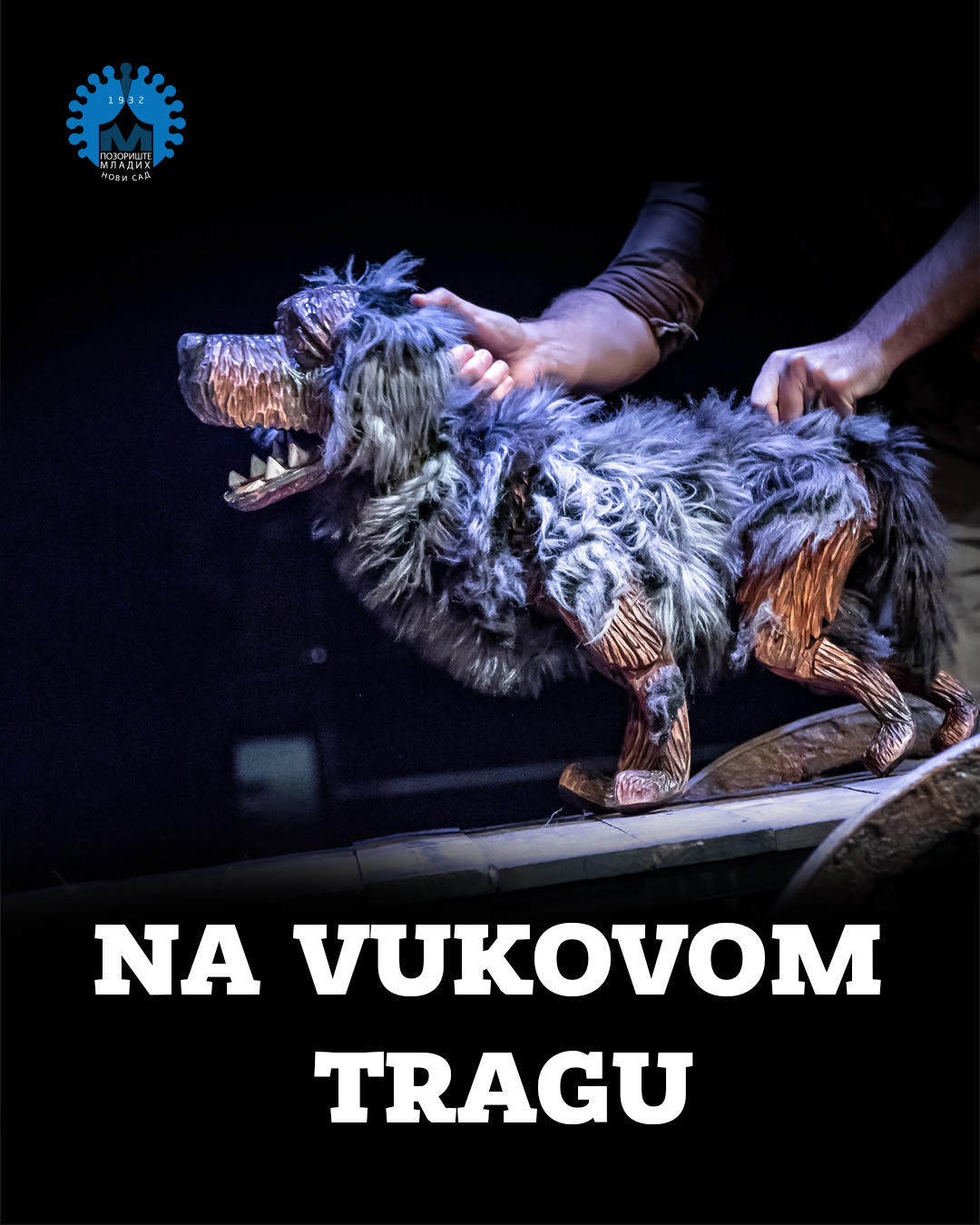
Jack London’s novel The Call of the Wild inspired Czech director Jakub Maksymov to create a theatrical composition for six actors, one drummer, ten microphones, four dogs, and one deer. On the Wolf’s Trail tells the story of Buck, a dog sold during the Gold Rush to work in the Canadian province. Buck’s life story is filled with hardships brought on by unfamiliar circumstances, but also by the uncompromising freedom awakening within him. The actors in this production push the boundaries of puppetry, and as they create a wondrous phantasmagoria on stage, they transport the audience into another dimension—making On the Wolf’s Trail feel like a small masterpiece.
Xenia and the Hunter is the story of a girl who struggles because she is different from her peers. However, once she realizes that her uniqueness is in fact her strength—and when she begins to rely on what she does best—a life lived to the fullest opens up before her. This is a powerful story about the value of perseverance and the importance of fighting for one’s dreams. Those who persist in pursuing their dreams make the world a different, better place to live in. Without them, there would be neither beauty nor art.
Cast: Ksenija Mitrović and Slobodan Ninković
Based on the story of the same name by Aleksandra Vrebalov
Director: Emilija Mrdaković
Dramaturgy: Teodora Marković
Concept, Puppet, Set and Costume Design: Adriana Dobreva
Music: Aleksandra Vrebalov
Duration: 60 minutes
Age: 5+
May 9, 2026, 7:00 p.m., Novi Sad Theatre / Újvidéki Színház
BANDITS
Youth Theatre, Novi Sad
Branislav Nušić’s Bandits, directed by Olja Đorđević, is a witty, high-spirited exploration of mentality and the spirit of the times—questioning the relationship between past and present, and reflecting youth against an outdated school system. Those unfamiliar with it will discover everything about the bandits of the 21st century: a skibidi crew that scams, targets, and heals, and when needed, also resolves and flexes. You’ll also hear who’s brain-rotted, who should be banned or supported, about cringe, and who qualifies as a sigma. In short—everything in one place, in 90 minutes. A theatre reader overdose.
Cast: Slavica Vučetić, Jelica Gligorin, Neda Danilović, Marija Radovanov, Uroš Lazović, Slobodan Ninković, Aleksa Ilić, Saša Latinović, Aleksandar Milković, and Ivan Đurić
Adaptation and Direction: Olja Đorđević
Set Design: Marija Kalabić
Costume Design: Milica Grbić Komazec
Music: Irena Popović Dragović
Movement Direction: Andreja Kulešević
Duration: 90 minutes
Age: 10+
May 12, 2026, 5:00 p.m., Youth Theatre
THE MAGIC FLUTE
Youth Theatre, Novi Sad
Mozart’s The Magic Flute, performed by the actors of the Youth Theatre, is a lively opera for children that introduces young audiences to a genre they will encounter later in life. Is the day brighter, or is the night more radiant? These are the questions posed through its rich musical score. In the direction of Renata Carola Gatica—an Argentine director based in Croatia—the production reveals the remarkable musical abilities of the Youth Theatre ensemble, thanks to which children leave each performance humming its well-known arias.
Cast: Saša Latinović, Uroš Lazović, Ksenija Mitrović, Slobodan Ninković, Marija Radovanov, and Aleksandar Milković
The outstanding Canadian production Macbeth Muet, performed by La Fille Du Laitier Theatre from Montreal, Quebec, Canada, has been awarded Best Performance at the 4th Novi Sad Theatre Festival. The Grand Prix was awarded by a jury composed of costume designer Irina Somborac, director Tamara Kučinović, and dramaturge Divna Stojanov.
In their statement, the jury praised the production for "creating a space for understanding Shakespeare’s tragedy through a simple and accessible form of communication with the audience, regardless of age." By bringing the tragic form closer to younger generations, Macbeth Muet “offered audiences a path to catharsis through its witty and eclectic approach to one of the most dramatic of Shakespeare’s works.”
Following the performances of all seven entries in the competition program, held from May 7 to 11 at the Youth Theatre, the jury awarded Best Directing to Macbeth Muet creators Marie-Hélène Bélanger Dumas and Jon Lachlan Stewart. The jury commended their minimalist yet impactful directorial concept, which skillfully revealed themes of murder and power:
"The performance space offered intelligent directorial solutions, with a precise play on symbols and meanings. The rapid succession of symbolic images and brief focus on events gave the performance a sense of lightness and delight.”
The same production also received the award for Outstanding Acting Performance, given to two of its remarkable cast members, Marie-Hélène Bélanger Dumas and Jérémy Francoeur, for “their impressive acting skills and ability to animate objects.” The jury highlighted their “remarkable synchronicity, precision, and unpretentiousness, as well as their talent, authenticity, and skill in balancing comedy and tragedy.”
The Award for Excellence in Animation went to Russian-born French artist Vera Rozanova for her role in Don’t Wait for Me…, performed by La neige sur les cils Theatre from Nantes, France. Her performance was recognized for “a simple yet expressive animation style that created an intimate connection with the characters’ emotional struggles.” The same production also received a Special Award for Visual Identity:
“All visual elements were stylistically consistent, playful, and functional. The puppets, in particular, left a strong impression with their simple yet expressive design, evoking warmth and a sense of home.”
The Special Award for Ensemble Performance went to the exceptional cast of the hilarious show The Adventures of Little Juju by Rijeka City Puppet Theatre (Croatia). The jury commended the group for their “dedication, unity, and energetic performance,” noting their skill in combining
After viewing more than 300 productions, the Artistic Council of the 5th International Festival of Professional Theatres for Children and Young People “Novi Sad Theatre Festival”, consisting of Slavica Vučetić (Chair), Neda Danilović (Member), and Saša Latinović (Member), unanimously adopted the following:
Selection of the 5th International Festival of Professional Theatres for Children and Young People
“Novi Sad Theatre Festival” 7–12 May 2026
Trukitrek, Ciutadella de Menorca, Menorca, Spain
CLICK
Author: Josep Piris and Lu Pulici
Director: Josep Piris
Cie Mangano-Massip, Bonny sur Loire, France
ALICE IN WONDERBOX
Authors: Sara Mangano and Pierre-Yves Massip
Director: Sara Mangano and Pierre-Yves Massip
ALFA Theatre and Contributory org. Pilsen, Czech Republic
THE JOURNEY OF THE GOOD HANS BÖHM THROUGH EUROPE
Author: Tomsa Legierski, Petra Kosová & Co. (theme: Jan Jeňýk Valeš)
Director: Tomsa Legierski
TMEL, Prague, Czech Republic
THE NEST
Author: TMEL collective
Director: Viktor Prokop
Puppet Theatre Maribor, Maribor, Slovenia
PINOCCHIO
Author: Carlo Collodi and Matteo Spiazzi
Director: Matteo Spiazzi
The Key Theatre Tel Aviv, Israel
DON’T POKE THE BEAR
Author: Avi Zlicha and Dikla Katz
Director: Avi Zlicha and Dikla Katz
Le Friiix Club, Bordeaux, France
SHA DOIZO
Author: Frédéric Feliciano
Director: Frédéric Feliciano
National Theatre „Toša Jovanović“, Zrenjanin, Serbia
ANDRACI, JEPURI AND OTHER MOST IMPORTANT MONSTERS OF PETROVGRAD AND MIDDLE BANAT
Author: Nikola Zavišić
Director: Nikola Zavišić
City Puppet Theatre Rijeka, Rijeka, Croatia
SWEET WORDS
Author: Carl Norac
Director: Mateja Bizjak Petit
Director of the International Festival of
professional theaters for children and young people
The fourth International Festival of Professional Theatres for Children and Youth, Novi Sad Theatre Festival 2025 (May 7–11), concluded with the Canadian production Macbeth Muet, based on William Shakespeare's tragedy Macbeth. The play was performed by the touring theatre company La Fille Du Laitier from Montreal/Quebec, and hosted at the Youth Theatre in Novi Sad on May 11.
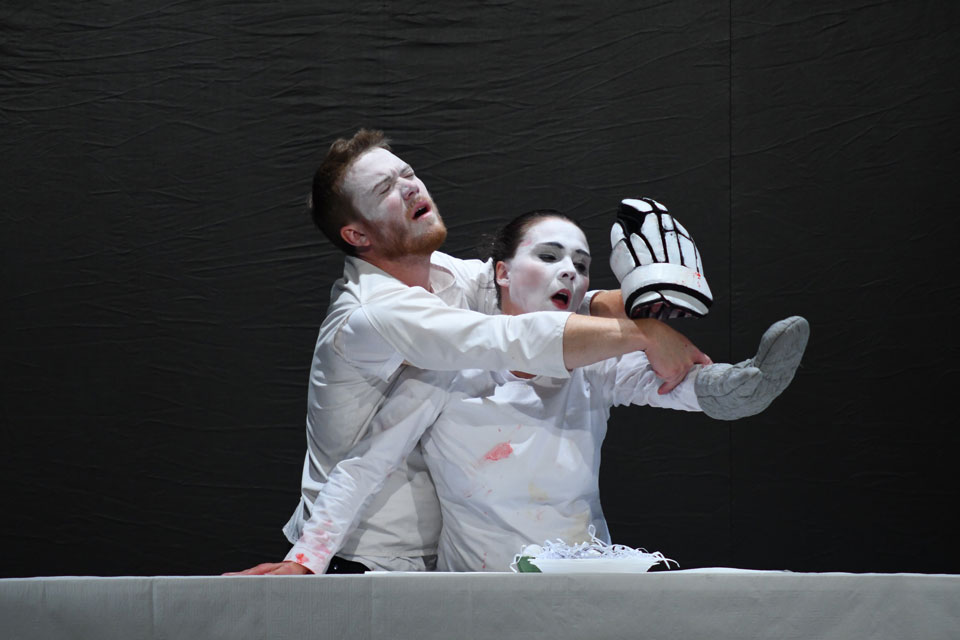
Marie-Hélène Bélanger Dumas and Jon Lachlan Stewart are the creators of the production and the puppet designers (alongside set and costume designer Cédric Lord), while Bélanger Dumas and Jérémie Francoeur perform in this exceptional and, in many ways, fascinating show. The performance follows Macbeth’s (Francoeur) descent from his fateful encounter with the Fates (represented by black paper “origami frogs”) and his return to Lady Macbeth (Bélanger Dumas), through interactions with key characters: Banquo (a white plastic plate with two black circles for eyes—his wife is a similar plate with a hair bow, and their son is a small plate), Macduff (represented by a knight’s glove, with his wife portrayed by a soft mitten), and the King (a playing card – the king of hearts).
Family dynamics are depicted with remarkable creativity, including both passionate and tender erotic moments and the symbolic or violent deaths of children (represented by breaking eggs), typically followed by murder. Although we are aware that these are theatrical illusions, the blood (red-dyed corn syrup) splashes convincingly across the stage, and the actors' facial expressions carry genuine menace.
The story is rich with both grim and humorous details that do not distract from the narrative but rather enhance its dark impact. Everyday objects—plastic plates and cups, egg cartons, candlesticks, signs, and scrolls—lose their original function in this new context and become integral to the eerie and bloody atmosphere. This is particularly evident in the choice of music (by Jon Lachlan Stewart), where light, nostalgic pop melodies often foreshadow ominous events.
It may seem unusual for a Shakespearean play—written by a master of language—to be performed like a silent film. However, in a post-show discussion, Bélanger Dumas explained this approach as a deliberate attempt to preserve the spirit and atmosphere of the Bard’s work without diminishing the power of his metaphor-rich and poetic language.
Macbeth Muet is the kind of rare theatrical experience where artistic intelligence and audience enjoyment are tightly intertwined.
Youth Theater, Novi Sadinvites all professional theaters to submit their applications for the Novi Sad Theatre Festival, fifth international theater festival for children and youth, which will be held in Novi Sad in in the second week of May 2026.
All types of theater creation for children and youth are represented at the Festival. The Youth Theater, Novi Sad, the organizer of the festival, provides accommodation and food for the participants as well as travel expenses in the total amount up to 2.000 EUR.
The Novi Sad Theatre Festival is a competitive festival, and the awards will be decided by an international expert jury.
The deadline for applications is November 15, 2025, and the selection will be announced no later than January 15, 2026.
Please send the completed Application form and video links of the performances to the following e-mail address: This email address is being protected from spambots. You need JavaScript enabled to view it.
Please complete the application form in English.
Other materials, not available in electronic form, can be sent by mail to the theater address:
Among the diverse formats presented at the 4th Novi Sad Theatre Festival — from puppet shows to live-action plays, from performances for toddlers to those targeting young adult audiences — the festival concluded with the wordless performance Macbeth Muet by La Fille Du Laitier Theatre from Montreal, Canada. The production was honored with three festival awards: the Grand Prix for Best Overall Production, Best Direction, and Outstanding Acting Performance.
Macbeth Muet remains true to Shakespeare’s famed tragedy — with the striking difference that not a single word is spoken. The creators, Marie-Hélène Bélanger Dumas and Jon Lachlan Stewart, who also perform alongside Jérémy Francoeur, condense the story of Macbeth into a fast-paced 60-minute piece. While largely following the sequence of Shakespeare’s original, the narrative is conveyed through movement and creative use of props, some of which double as puppets. The result is a brisk, rhythmically sharp performance in which key scenes are reduced to a few essential gestures that efficiently carry the plot forward.
The two performers primarily take on the roles of Macbeth and Lady Macbeth, while supporting characters are portrayed through animated objects using puppetry techniques — though they occasionally embody secondary characters themselves. Battle scenes are rendered through choreographed duels and the spilling of red paint from small cups, while Macbeth’s spirals into guilt and paranoia are brought to life through Jérémy Francoeur’s intense, spasmodic movements. The couple’s initial encounter is presented in a stylized, absurdly comic prologue — a caricature of sex, followed by the smashing of eggs, symbolizing their infertility. Throughout the performance, the actors wear white shirts that gradually become stained with egg, paint, and grime — a visible metaphor for their characters' moral decay.
In its aesthetic and referential approach to culture, Macbeth Muet can be described as thoroughly postmodern. Drawing on classical literature and theatre, the show presumes at least a basic familiarity with Shakespeare’s Macbeth to fully grasp the storyline. It also takes cues from silent film — not just through mime and theatrical movement, but with paper title cards that simulate intertitles, providing both context and guidance (e.g., Prologue). Music plays a crucial role — not merely as background, but as an active narrative force. Jon Lachlan Stewart’s soundtrack, a collage of excerpts spanning classical, pop, and hip-hop, reinforces the show’s postmodern nature. One particularly telling moment is Lady Macbeth’s descent into madness, accompanied by Simon & Garfunkel’s The Sound of Silence (“Hello darkness, my old friend”), highlighting the production’s self-awareness and dark humor. Similarly, irreverent captions like “Macbeth just got fate-f*cked” add to the show’s ironic tone.
Yet, as with many postmodern works, Macbeth Muet’s heavy reliance on irony and cultural references risks becoming self-serving. The performance often indulges in pastiche without fully articulating its purpose, and it notably avoids deeper interpretation of the tragedy’s psychological and moral themes. With a lesser piece, such an approach might warrant a harsher critique. But here, the production’s playful inventiveness and near-flawless pacing make it hard to begrudge. Macbeth Muet succeeds in being clever, energetic, and unapologetically bold — and that, in the end, is its greatest strength.
Darkness. Applause echoes as the floodlights come on, revealing the cast bowing to the audience. Fists raised in defiance, a whistle blown—this closing tableau isn't just a curtain call; it’s a symbolic gesture. The applause intensifies, not just in admiration for the performance, but in recognition of its political stance.
Six months into the ongoing student and civil protests in Serbia, theater has become a platform for subtle (and not-so-subtle) acts of resistance. Many ensembles have voiced solidarity with the demonstrators, often through gestures that feel tacked onto plays unrelated to the struggle. But the Youth Theater’s new production of Dragon, directed by Russian artist Lyudmila Fyodorova, is different. Here, the message of rebellion is embedded in the very DNA of the play.
Schwartz’s Dragon, written in 1943, is an adult fairy tale with sharp allegorical teeth. Set in a fictional city long ruled by a brutal, three-headed dragon, the story casts tyranny not as a sudden imposition, but as a deep-rooted system. The dragon can shift into human form, symbolizing the fluid, pervasive nature of authoritarianism. While Schwartz originally wrote the piece as a satire of Nazism, Soviet authorities recognized its broader critique of dictatorship and banned its 1944 Moscow premiere. That alone speaks to the enduring potency of the play.
What makes Dragon especially relevant today is its critique of passive complicity. The oppressed citizens have grown so used to their chains that they maintain them willingly—offering young girls as sacrifices, justifying repression for the sake of “stability.” This “stabilocracy,” as the term might suggest, reflects not just historical fascism but eerily mirrors modern autocratic tendencies, including those in present-day Serbia. Enter Lancelot, the traveling knight, who aims to free the city—not just from the dragon, but from the apathy that sustains it.
Fyodorova’s direction emphasizes this allegory unapologetically. The fairy-tale aesthetic takes a back seat to stark symbolism. Andrej Zaparoški’s set is dominated by a looming metal cage—more prison than palace. Puppetry, masks, and stylized movements are used to chilling effect. Citizens wear pale, ghostlike masks with hints of rouge, appearing as zombified followers (bots, or maybe ćaci?). Elsa, the chosen sacrifice and Lancelot’s love interest, is literally caged, her presence split between a live actress (Ksenija Mitrović) and a marionette version of herself animated by Neda Danilović and Slavica Vučetić. This duality reinforces her powerlessness.
Interestingly, the most complex character is not the hero, but the villain. While Aleksa Ilić plays Lancelot with the firm resolve of a classic fairytale hero, the dragon appears in three haunting forms: as a decrepit, masked elder (body by Marija Radovanov, voice by Ivan Đurić); as a grotesque puppet head (manipulated by Slobodan Ninković and Uroš Lazović); and finally, in a disturbingly human form portrayed by Đurić himself. This multifaceted portrayal underscores how tyranny can shift, hide, and re-emerge.
The mayor, the dragon’s sycophantic deputy, is another standout. Saša Latinović gives a bravura performance, channeling a character who feigns madness to dodge responsibility. He’s manipulative, eccentric, and disturbingly familiar. Lines like “Son, I’m the mayor. I haven’t been telling myself the truth for years,” land with uncomfortable resonance. However, the portrayal is not without issue: the character’s supposed madness is partly symbolized through transvestism and feminized traits, a problematic trope that inadvertently stigmatizes gender nonconformity. This misstep implicates the director, performers, and costume design alike.
Gender representation more broadly remains a weak spot—rooted not in this production’s choices but in Schwartz’s original text. Female characters are passive, victimized, or peripheral, while men dominate both oppression and liberation. Only a radical reimagining of the script could have altered this, but it remains a limitation that shouldn’t be overlooked.
Politically, Dragon doesn’t stop at a simple good-vs-evil arc. After the dragon is slain, Lancelot returns a year later only to find the people still trapped—this time under the mayor’s tyranny. As the mayor chillingly observes, “The deceased trained them to drive anyone who took the reins.” The dragon may be dead, but his ideology lives on in the minds of the people. In the final moments, a mass of masked citizens stares directly at the audience—a stark, accusatory reflection. And yet, hope glimmers. Lancelot is still here. The chirping of a bird breaks the silence. The actors remove their masks and turn toward the sound of life. It’s a direct, if slightly on-the-nose, symbol of change. But it works.
In this turbulent moment for Serbia, Dragon doesn’t just reflect the times—it engages with them. It reminds us that the battle against autocracy isn’t only external. It’s a psychological struggle, too, against the violence and fear that settle into the soul. Real change takes time. But as this production makes clear, it is possible—and worth fighting for.
In a time when hostility toward migrants is once again on the rise in the West—despite countless historical warnings about the destructiveness of xenophobia—migration remains an essential part of the human experience. Movement is at the heart of life itself. Whether we cross national borders or simply move from one neighborhood to another, we all experience displacement in some form. In that sense, the questions of home and belonging are deeply existential and universally human.
Vera Rozanova, a theatre and puppetry artist who left her native Russia for France in 2011, explores these themes in her play Don’t Wait for Me…, produced at La neige sur les cils Theatre in Nantes and recently performed at the Novi Sad Theatre Festival. In this poetic, darkly whimsical production, Rozanova conjures a world where houses grow legs and walk away from their inhabitants. It’s a surreal inversion of reality—where we do not leave home, but rather, home leaves us. Still, it reflects a painful truth: becoming homeless is often not a choice.
The play, aimed at children aged six and up, follows a small, gray figure on a quest to find the house that left him. Along the way, he encounters others like himself, as well as more walking houses, each with a story of its own. Rozanova, who both wrote and directed the play, also performs all the puppet roles herself, showcasing remarkable dexterity and emotional nuance across multiple characters during the 40-minute performance.
Visually, the play is enveloped in dark, bluish hues, evoking a never-ending night. Designed by Lucille Regier and Sammy Barra, the set creates a dreamlike landscape filled with lanky, tousled human figures who seem perpetually lost, as though just awoken from sleep in a world they no longer recognize. Yet amidst the confusion and loss, small moments of connection—between characters and their anthropomorphic homes—inject warmth and hope into the narrative.
Rozanova’s performance is particularly impressive not only for her puppeteering, but also for her multilingual delivery. While the play is performed in French and Russian in Nantes, she adapted it for Novi Sad with French, Serbian, and English, with English subtitles providing accessibility for an international audience. This multilingual approach subtly highlights another migrant reality: the fragmented, in-between linguistic identity that often comes with displacement. Migrants may speak several languages, yet feel fully at home in none. This linguistic and cultural ambiguity permeates the performance with a palpable sense of melancholy.
Still, migration is not only marked by sadness. It also brings richness and diversity. Isn’t it a beautiful thing that children in both Nantes and Novi Sad can engage with Don’t Wait for Me… in their own languages, while also hearing unfamiliar ones? It’s an experience that broadens horizons and deepens empathy. That’s why, when Rozanova—animating a migratory bird puppet—breaks the fourth wall at the end of the show and tells the audience, “This is my story, but it could be yours too,” it’s both a gentle warning and a hopeful promise. Migration, she reminds us, brings new challenges and sorrows—but also the possibility of unexpected beauty and growth.
The time of frozen catharsis is now. But what kind of theatre refuses purification? Theatre performances and projects today often ignore the audience as a moral judge. However, this is almost impossible at the Novi Sad Theatre Festival. There, the auditorium is filled with the youngest ones, which is why theatre posters read “3+”, “6+”… or teenagers trying to navigate their own coming of age, to find their path and discover what are young people actually looking for in theatre — but also older viewers, parents, caregivers, teachers, grandparents, educators, fully formed personalities who, deep inside, carry an inner child ready to emerge at any moment — in the dimmed light, the playful song, puppet acrobatics, thrilling stage movement, effects — suddenly, into the spotlight.
It is an unflinchingly honest and discerning audience. An audience that doesn’t fall for cheap tricks or bad illusions. One who cannot be dazzled by glitter or sold smoke. It accepts only genuine emotion, a convincing story, and top-tier staging with no compromises. Here, the performance must be masterful, because every spectator (even aloud, unafraid, in the middle of theatrical silence) will unmask the illusion if it isn’t convincing enough. But precisely because of that, when it is convincing, the hall erupts in a collective cry of delight and a universal question: “What just happened?” This year, the Novi Sad audience was met by theatres from Croatia, the Czech Republic, France, Spain, Slovenia, and Canada, as well as our own children’s theatres from Novi Sad (Youth Theater) and Belgrade (Little theater Duško Radović).
The Youth Theater of Novi Sad has been the host of this international — one might even say global — festival for the fourth year in a row. In its nearly hundred-year existence, this institution stands as the first puppet theatre in Serbia, and countless generations of Novi Sad’s residents have grown up with its puppet and drama performances. Many lovingly refer to it simply as “The Little Theatre.” One friend of mine told me how her mother, quite by accident, always ended up buying tickets for the same play — Thumbelina (Palčica) — so she watched it countless times, and each time it felt as if it were the first. Another friend has sincerely believed, ever since the age of seven, and thanks to Hedgehog’s Home (Ježeva kućica), that this is the only real theatre in the world. I loved watching An Angel’s Fairy Tale (Anđeoska bajka), directed by Emilija Mrdaković — after whom, quite by chance, I was named — and as far as I can remember, the play was truly exceptional. Some of those performances are still on the repertoire, and alongside provocative novelties and a fresh theatrical language, they demonstrate timeless beauty and value. Still, this festival is a special treasure. It brings the children and youth of Novi Sad other and different theatrical approaches, new and exciting puppets, and wonderful people from around the world who have never forgotten how to play, and how to share that joy.
Contemporary theatre for children and youth is in serious danger from the adult world that tries to “buy” children through art, instead of truly listening to them. And yet, kids today are expressing authenticity more than ever. In the theatre, they feel at home — some even took off their shoes during the performance. Some, carried away by enthusiasm, stood up from their seats and remained standing, no matter how much they were asked to sit down, hypnotised by the plot and thrilled by the scene. Every single one of them clapped passionately and thunderously the moment the lights dimmed and something spectacular happened. These are children who are not afraid of (theatre) darkness — they welcome it with immense excitement. A time has come when children must be given the space to develop their inner worlds. A time in which theatre must learn to be silent, to wait, to watch and listen — to allow children to speak, instead of serving them answers.
During the performance of The Pilot and the Little Prince, directed by Jakub Maksymov and staged by the Puppet Theatre Ostrava from the Czech Republic, a boy, maybe six or seven years old, was sitting in the eleventh row. He could read. And he read the translation aloud to his friends, dramatically, sincerely, authentically—with such enthusiasm that everyone around him listened intently, as if to a perfect extension of the play, one no adult could ever have conceived. Theatre of the new era, for children and youth, must therefore inspire a new kind of dedication and responsibility among adult artists: how to become nurturers, not overseers? How can we create a space where children can grow freely rather than be shaped? Because in those rare and radiant moments — when a child realises that theatre is not an imitation of the world, but a space where they can change it — unpredictable magic is born.
The play The Pilot and the Little Prince, which traces the life of Antoine de Saint-Exupéry, tells the story of a real man’s triumphs and defeats. Before a young audience, it unveils the world of early aviation — a time when humankind first began to part from the earth and reach toward the sky. But the performance also explores Antoine’s childhood and everyday moments, his dreams and imagination, through song, movement, and the sound of the accordion. On stage, a second, imaginative realm emerges — the puppet of Saint-Exupéry (who vanished without a trace on a reconnaissance mission, lost in the desert sands) stands opposite the puppet of the Little Prince. In the stunned silence of collective awe, a young girl from the audience exclaimed: “That’s his soul!” And indeed, it is. Because the clouds in the sky will never be just screens. Though at first glance the play may seem overly complex, filled with historical references and terms such as World War II, with models of early aeroplanes and explanations of how they worked, and scenes that evoke the terror of wartime bombing, it is, at its core, profoundly clear. And far from distant from the soul of every child in the audience. It is wrapped in a box containing the perfect drawing of a sheep.
And like many others, I am afraid of my inner child — of what it might draw, what it might say, what it might write right now. I fear the snake and the elephant just as much as Juju fears the crocodile in the play The Adventures of Little Juju, staged by the City Puppet Theater Rijeka (Croatia) and directed by Renata Carola Gatica. Juju is no taller than a thumb, yet he knows the animals and speaks all of their languages. When the actor on stage says, “You know the story, but your mom and dad didn’t tell you everything…”, a chorus of children erupts from the audience: “They did!” In their tone, I recognise a note of something more — a resonance that says: adults, and parents above all, are going to ruin us. Crocodile tears fall for those who have forgotten how to play. The fear of the crocodile, the snake, the elephant — the fear of the authentic Self we abandoned in childhood, of buried ideas and forgotten solutions, of the freedom to speak, of a theatre that strips away not only the darkness of the world, but also reveals its boundless beauty — all of this is held in a single drawing that looks, at first glance, like a hat… but is actually a snake that has swallowed an elephant.
One cannot hide in the darkness of the theatre. Everything suppressed—emotions, memories, fears, truths—inevitably surfaces. The rebellion silenced above the stage, and the audience eventually spills into the streets. The little children who now attend theatre will grow into teenagers who know exactly what they are looking for in art and theatre; into students who, without hesitation, stand behind their truth; into adults who no longer accept bad acting, cheap illusions, or deception wrapped in stage lights—they refuse hollow lives.
Plato spoke of death as the separation of the soul from the body. Aristotle said that catharsis is the aesthetic cleansing of the soul of the one who observes an artwork. And a little girl in the audience at the Youth Theater Novi Sad, during a performance in Czech—a language she could not understand—understood nonetheless. She recognised the soul. She pointed to it. And she named it. “That’s his soul!” she shouted.
And you? You must find your own soul, your own catharsis. Perhaps in the theatre. Perhaps right there in the dark.
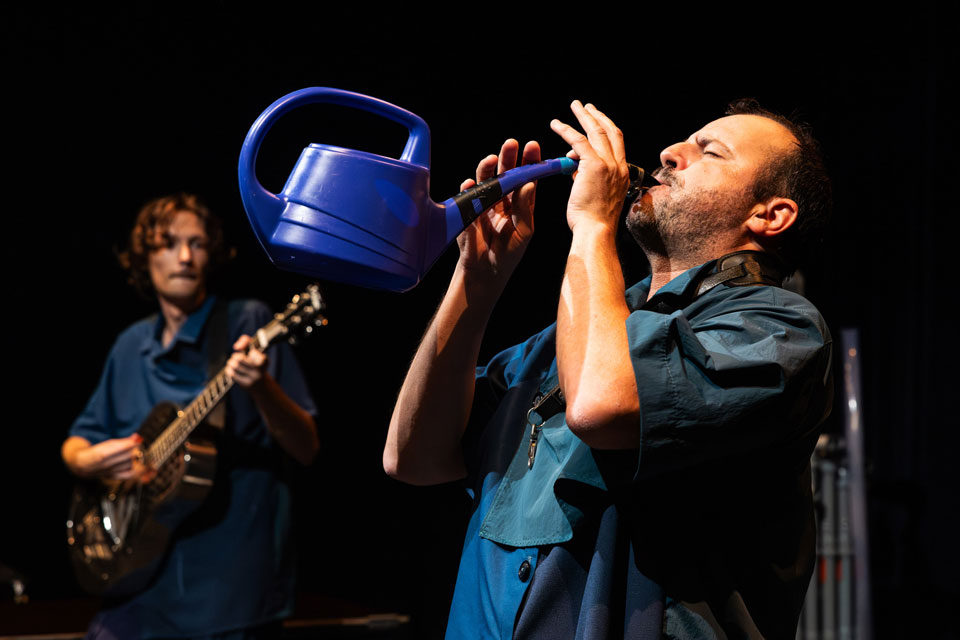
Peter Kus is known as both a musician and puppeteer, and his performances often feature inventive instruments of his own design. His latest piece, Bloop, co-directed and performed alongside Filip Šebšajević and Gašper Lovrec, was no exception. Presented by the Kuskus Institute and Art Production Ljubljana (Slovenia) on the penultimate day of the 4th International Novi Sad Theater Festival 2025 (Youth Theater, Novi Sad, May 10), the performance was a visually engaging and sonically rich experience.
The importance of water—essential not only to human life but to the entire planet—is a message that hardly needs repeating. Yet human negligence continues to pose serious threats, and Bloop aims to address this with humor and creativity. In a lab-like setting (clever and imaginative set design by Primož Mihevc, atmospheric lighting by Borut Bučine), a strange aquatic creature named Bloop suddenly appears. His arrival brings a collection of plumbing-related objects to life (playful and inventive puppets by Katarina Cakova), prompting three scientists—dressed in charming costumes by Iztok Hrga—to explore water in all its forms. The narrative, shaped by Maria Giulia Campioli, attempts to weave these elements into a cohesive story.
While the scenes are creatively staged and often delivered with humor, the overarching narrative lacks clarity. The connection between Bloop and the scientists’ experiments feels underdeveloped, making the ecological message and character dynamics occasionally hard to follow. In casual terms, the story doesn't quite "hold water."
However, where Bloop truly shines is in its soundscape. As in Kus’s previous work, the performance is filled with dazzling musicianship. Instruments made from everyday objects—plastic buckets, watering cans, metal tubs, even pumpkin shells—are transformed into sources of music, often using simple additions like pipes or strings. These sound experiments, both whimsical and precise, captivated the audience, particularly the younger viewers.
Post-show discussions revealed that children were most drawn to the physical and mechanical properties of water and the playful musical inventions. They responded enthusiastically to the hands-on, scientific feel of the performance, which speaks volumes about the piece’s educational potential.
One can’t help but wonder whether Bloop might have been more powerful had it embraced its strengths—instrument-building, music-making, and playful scientific exploration—rather than striving to fit those elements into a loosely defined narrative. Still, the performance offers a rich sensory experience rather than opens the door for children to think about ….