



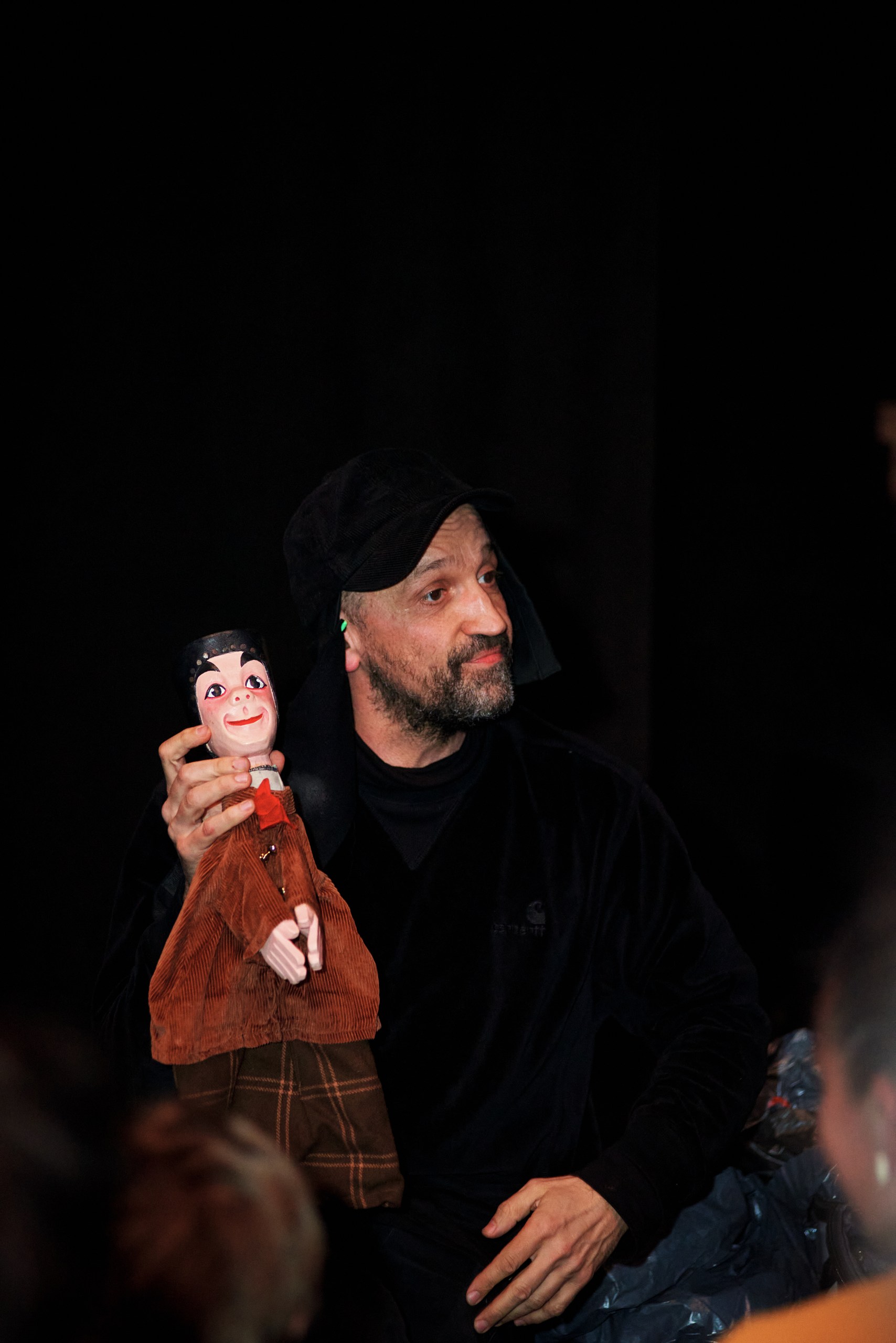
At this year’s festival, we saw a number of performances exploring new technologies and their impact on contemporary life — some looking toward the future, others delving deep into the human soul. One production, however, stood out in a special way because it was created for the youngest audience imaginable: children barely a year old.
Sha Doizo, from Bordeaux, was performed by French animator Frédéric Feliciano, who reminded us how far our hands and fingers can take us when imagination is allowed to run free. Yet Feliciano was perhaps even more enchanting after the performance itself, when he stayed to interact with the audience, revealing the tricks and secrets behind his animation. It soon became clear that he had already discovered several remarkably talented little animators among the crowd — children who might one day follow in his footsteps.
What inspired this miniature, delicate, and imaginative theatrical story intended almost for babies?
I was inspired by black theater, by nonverbal works from the 1960s and ’80s, and by the music of those decades. There’s also a little bit of La Linea in it. I always allow myself to be inspired by anthropology and science as well.
How long have you been working in children’s theater?
Ten years.
What matters most when creating theater for such a young audience — children this tiny? Does it have to be entertaining?
Not necessarily. What matters is that the performance contains elements they recognize from everyday life — things they can place somewhere within their imagination, within their minds.
I can create a performance inspired by anthropology or by certain drawings, but the lines that make up those drawings must still be recognizable to them. When one child recognizes something, they react, and then the others begin reacting too, because they feel free to join in.
The same thing happens with laughter: if one child starts laughing, the laughter spreads. But if one child becomes frightened, that spreads as well. The collective experience is very important — shared recognition within the group — and everything begins with surprise.
And when they cry or become scared, what do you do then?
That means the surprise frightened them because they can’t place it anywhere. They don’t recognize it. It surprised them too much. They stop crying once they manage to identify it — once they can connect it to something familiar — and parents can help a little with that.
Who makes up the Le Friiix Club?
There are several of us. The collective has been around for twelve years, and we collaborate with a variety of artists. One of them is Jacques Ballue, who composed the music for this performance.
What should contemporary theater focus on today? What should it concern itself with?
Theater — good theater — needs energy and momentum. It needs movement in thought, and poetry in thought. It can deal with anything: morality, social issues, personal struggles — whatever the subject may be — but there has to be a sense of vitality in the way it’s created and performed.
If I’m making a piece about ecology, for example, the actions on stage have to carry meaningful energy and purpose. Otherwise, the subject loses its force. That sense of dynamism is especially important during the creative process itself. Theater still needs to be engaged with the world, even though culture has changed. We still have a responsibility to speak honestly to young people.
Your hands and fingers are where your art lives. How do you take care of them? Do you have a special cream, exercises, some kind of ritual? I assume regular hand washing is part of it :)
That’s a good one! Yes, of course, I wash my hands every day, but there’s no secret treatment for my hands or fingers — I don’t even do exercises. I just try not to injure them. The only real way I care for them is by trying to find poetry within them.