



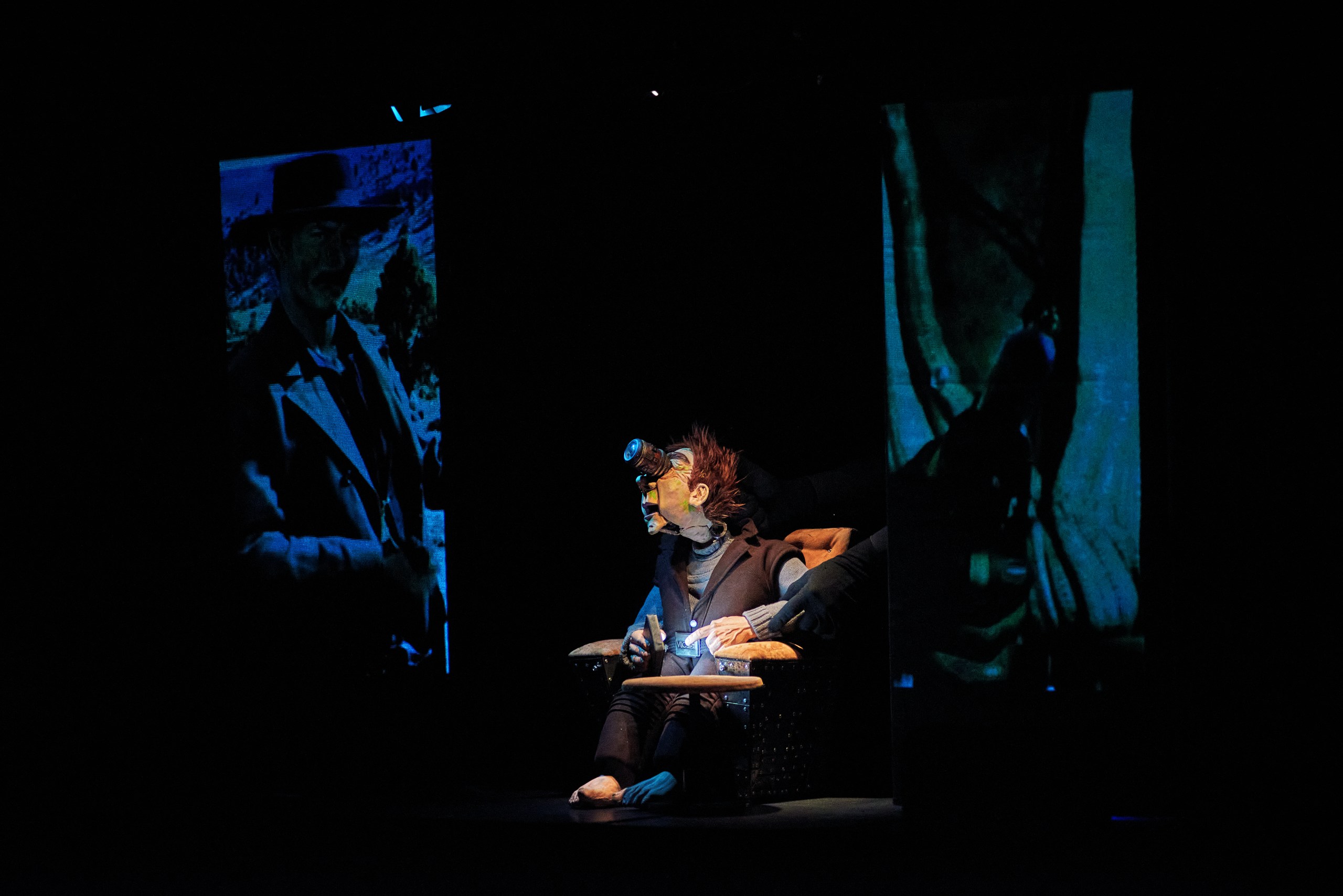
In philosophy, there is the well-known paradox of the Ship of Theseus: “If every part of a ship is replaced one by one, is it still the same ship?” The performance Click, created and performed by Josep Piris and Lu Pulicí from the theater company Trukitrek, Menorca, Spain, poses what might be called a biological-mechanical paradox: “If a human being’s organs are replaced one by one with mechanical ones, does that person remain human — and the same person?”
What is it that makes a human being truly human, especially in a civilization that has turned its back on the very nature it belongs to? According to the creators of Click, the answer is the human heart.
“Only what comes from the heart can reach the hearts of others,” says Goethe’s Faust. In Click however, Faust’s heart symbolically contains the final fragment of the soul and of humanity itself, and the fate of that soul serves as both warning and prophecy — a vision of what may happen to our hearts if we blindly surrender ourselves to technology.
Set in a post-apocalyptic world, the play follows an aging recluse who spends his days receiving notifications from the sinister corporation Mephisto, urging him to improve his health by replacing parts of his body with machines. Faust’s world is claustrophobic, reduced to a narrow opening flooded by the cold glow of screens, where every “click” becomes a conscious act of consent to the gradual disappearance of his humanity.
His resistance to this digital tyranny is not loud or heroic, but expressed through tiny trembling gestures and a desperate attempt to preserve the last organic part of himself that corporate algorithms are trying to take away. One by one, his vital organs are replaced: first the stomach, then the eye, the brain, and finally the heart itself. The production’s greatest weakness lies in its predictability and repetition; the operation scenes unfold almost identically each time, repeated three times with little variation.
One could continue endlessly unpacking the meanings embedded in Click, but at its core the narrative offers a dystopian vision of technology as something that steals our souls, consumes our time, and distances us from nature. While these ideas are hardly new — and while the production somewhat simplistically repeats the false binary of humanity versus nature — it is still refreshing to see a performance for young audiences that embraces elements of horror.
Unlike film, theater cannot rely on editing, close-ups, illusion, or special effects to create fear, which makes horror particularly difficult to achieve on stage. In Click, horror emerges primarily through aesthetics: mechanical jerks and spasms, unnatural movements that defy human anatomy, the liminal stage space, the darkness from which the puppet-like Mephisto application suddenly appears, the blood and organ-replacement surgeries, the futuristic masks worn by the performers, and the music that constantly cultivates unease. Horror as a genre resonates strongly with audiences at an age when they are testing the boundaries of fear, and in that sense the performance is genuinely exciting. Yet despite all its darkness, Click is not entirely bleak. In the end, it insists on the idea that a fragment of humanity survives within us, even when our organs have been replaced.
The puppetry of Faust was extraordinary — precise, fluid, and refined to the smallest movement. It was perhaps the production’s most effective element. Mephisto, a digital phantom created through the fusion of a human hand and a rabbit-like puppet, deepened the play’s unsettling atmosphere. Emerging from the darkness again and again, he persistently urges Faust to accept another offer and surrender yet another organ, amplifying the horror at the heart of the story.
Much like the performance Alice in the Wonder Box, which similarly warns against internet abuse and the dangers of technological obsession, Click perhaps leaves one crucial contemporary question insufficiently explored — particularly for a generation that has grown up with phones seemingly fused to their hands from childhood onward: if we were to set aside our phones and tablets, one by one, what kind of life would remain for us then?